Those hot days of summer weeding have gone on hiatus, and forced us into another ever so comfortable condition, weeding in the rain. Eric and I spent a good portion of our afternoon weeding in the garden, only to find that the snap peas we were so careful to uncover actually needed the weeds! They give the plants support and which produces a bigger pea pod. It’s hard to resist eating all the snap peas as you go through weeding; they’re so delicious!
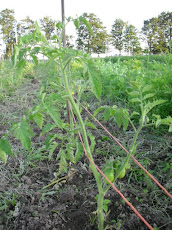
Since the pole beans have begun to stretch out over the ground, going well beyond their small seedling stature, Eric and I posted up long sticks in a tee-pee like formation around the beans. These beans were planted in circles, and will need the sticks to twine up around when they really start to grow. This type of vertical gardening if you will, is a great way to produce a lot without taking up space in your yard. So all you bean lovers out there should give it a try! And once the sticks are completely covered with the bean plants, it’ll look like kind of like a Christmas tree! And really, who doesn’t want one of those in their yard?
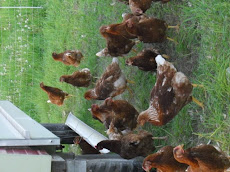
On a more morbid note, Eric the intern found 5 dead chickens when he went to go feed them yesterday morning. We were unsure of the cause until Eric the farmer caught a raccoon in the coop when he went to close it up last night. It’s more than likely the raccoon played a role in the massacre, but still, chickens were pecking at their dead peers…. When I let them out this morning, instead of flocking right to their food, as they usually do, most strutted right over to where left over feathers sat on the ground…. Also, I noticed more food left over this afternoon… So yea, some funny business goin’ on with the chickens, maybe there’s more food because there’s less of them now, or perhaps it’s because their too full after eating their dead sisters? Who really knows…
Monday, June 29, 2009

Thursday, June 25, 2009
Life on an organic farm is… hot, sweaty, dirty and intense when bailing hay…..
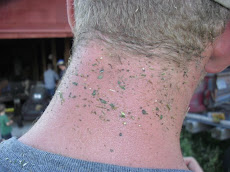
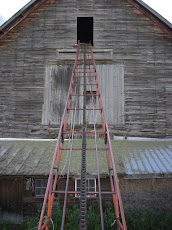
So the dreaded act of farming, the one that I had been warned about by at least 5 men upon saying that I was working on a farm, two being my grandfathers, finally arrived yesterday. Bailing the first part of the first cut of hay left us in nothing but sweat, with hay sticking to that sweat and a yearning desire to emerge our bodies into the pond. Ellyn and I loaded the hay from the wagons onto the conveyer belt to the barn, as Richard and his brother brought them in from the fields, and the Eric’s piled them up in the barn. It was the first day that finally felt like summer weather. The weather when cutting up fields for bailing, and the transition to the barn must be as idealist as possible, and boy did we feel it. Ellyn and I were sweating up a storm outside, but got a laugh when Eric the intern emerged from the sweltering hot barn with his t-shirt drenched in sweat after the first load. A workout it was, and after we finished the first of the 11 wagon filled with hay, equaling 1,600 bails for the 11 wagons, I downed Gatorade like it was the last thing I’d ever be able to drink. It didn’t take me long to regret my intake as I could feel it in my stomach, and never wish to drink that stuff ever again. Gotta love that high fructose corn syrup.... As the cows blissfully grassed away in the field from 1 to 7 yesterday, we began the grueling processes of making sure they have enough hay to eat throughout the winter; and they say humans are the higher species. The three of us interns jumped in the pond in our nasty clothes when we finished up, and I must say, it was probably one of the most refreshing experiences I’ve ever had in my life. :)
Today, the sun beat down on us, but once again, the cool water of the pond felt perfect as it washed away our grotesque bodies, and made the day’s work worth it. As the weather changes, we find ourselves switching from jeans and boots to shorts and sneakers, leaving the dirt to attractively stick to the sweat on the backs of our legs as we weed in the fields, where every minute it seems, you break to find a inch of clean space on your arm to wipe the sweat off your upper lip.
It’s as far a life from glamorous as you could imagine, but we’re supplying Upstate Vermonters with clean, healthy, fresh produce and beef from the most content cows around, making these intense days all the more worthwhile when the work is complete. Today, as I dried off from my swim, by laying down and reading about Micheal J. Fox's life on the grass, our chicken friend came up right next to me, but quickly jumped back a couple feet when I looked up from my book. I continued to read as clothes blew dry above me on the line in the breeze, could hear Maddie and Calvin laughing in their water buckets, and hear Heart (our calf) mooing in the background, and couldn't help but thinking that apart from the work, this truely is pretty close to paradise.
Today, the sun beat down on us, but once again, the cool water of the pond felt perfect as it washed away our grotesque bodies, and made the day’s work worth it. As the weather changes, we find ourselves switching from jeans and boots to shorts and sneakers, leaving the dirt to attractively stick to the sweat on the backs of our legs as we weed in the fields, where every minute it seems, you break to find a inch of clean space on your arm to wipe the sweat off your upper lip.
It’s as far a life from glamorous as you could imagine, but we’re supplying Upstate Vermonters with clean, healthy, fresh produce and beef from the most content cows around, making these intense days all the more worthwhile when the work is complete. Today, as I dried off from my swim, by laying down and reading about Micheal J. Fox's life on the grass, our chicken friend came up right next to me, but quickly jumped back a couple feet when I looked up from my book. I continued to read as clothes blew dry above me on the line in the breeze, could hear Maddie and Calvin laughing in their water buckets, and hear Heart (our calf) mooing in the background, and couldn't help but thinking that apart from the work, this truely is pretty close to paradise.
Monday, June 22, 2009
Life on an organic farm is...put on hold when you drive into town for creemees (soft ice cream for you New Yorkers) at the local gas station...
One chicken has been keeping us company out in the field for the past week or so. She’ll remain fairly close to us as we travel too and from the field, and I’ll even hear her squawkin’ behind me when I’m bent down in a row digging in the dirt, look around and see her slowly inching towards me in her typical chicken-wobble head-strut. She never dines with her fellow chickens in their designated fenced in area, or lays her eggs in the coop, as she used to always lay her egg in the greenhouse. No, this chicken isn’t a conformist, she'll forage to find her own food and seems perfectly content doing so. I can’t blame her though as her peers aren’t always the brightest bunch. When I went to feed them this afternoon, at least 6 chickens were wandering around outside the fence by their coop. Once they heard me coming though, they flocked to the fence to get inside. I was able to pick one up and fling her over the fence so she could eat, but the others didn’t let me catch them, they’re loss if they want food. But eventually, most, not all, but most, of the outside stragglers found a hole in the fence to squeeze their way back in to chow down.
This afternoon, as we weeded rows with action hoes and transplanted flowers into their freshly stirred soil, Eric the farmer and Richard, Eric’s dad, drove the four-wheeler in between the potato rows with a plow attached to the back, to build up the mounds. As the plant of the potato continues to grow above ground, the dirt heap surrounding the plant must continue to build up steadily throughout the season. We watched the guys ride around in their farm equipment as we usually do, and I’m sure our chicken friend did as well. :)
This afternoon, as we weeded rows with action hoes and transplanted flowers into their freshly stirred soil, Eric the farmer and Richard, Eric’s dad, drove the four-wheeler in between the potato rows with a plow attached to the back, to build up the mounds. As the plant of the potato continues to grow above ground, the dirt heap surrounding the plant must continue to build up steadily throughout the season. We watched the guys ride around in their farm equipment as we usually do, and I’m sure our chicken friend did as well. :)
Sunday, June 21, 2009
Life on an organic farm is…. All about keeping the pests away....
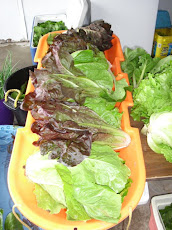
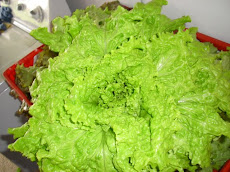
With our second CSA drop off tomorrow (Monday) in St. Albans, the Maplewood crew went to work this morning harvesting, washing and bagging our vegetables. Most of what we provided in our shares last week is again, what we will provide this week, but with some additions. Black Seeded Simpson and Red Fire heads of lettuce were ready for harvesting in the field! Such big and beauteous creations aid in the weeks harvest, which will only continuously grow in its bountifulness throughout the season.
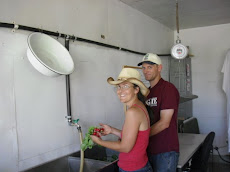
When we prepare for the CSA pickup (Community Supported Agriculture for those of you just logging on), the washing and bagging of the vegetables takes place in the milk room of the old dairy barn. It’s a break from the sun, or sometimes rain, the fields, flies and more, and to all our listening pleasure, allows us to crank up the radio to some classic hits on local radio stations, where Elton John is played at least twice... It’s vital that the harvesting be done in the morning, so that the vegetables don’t wilt in the hot sun towards the middle of the day. Weeding can’t be done right before harvesting, or you’d stir up unwanted extra dirt on your vegetables; and there’s already enough dirt, grass, hay and more to remove off the vegetables (lettuce especially) before bagging them!
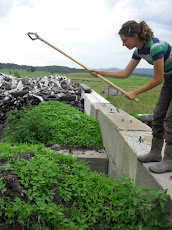
Between the almost instant spurts of sunshine and down pour in the field of Maplewood this afternoon, we weeded celery, eggplant and peppers. The last task of the day was searching through the many rows of potatoes for Colorado Potato Beetles! These little pests will eat at the potato leaves and lay their yellow eggs on the underside of the leaf. Three generations of this beetle can be produced in one summer, so they have the potential to be extremely damaging! Being an utmost importance that we squash them and their eggs when we spot them on the plant, I mashed one freeloader between my fingers, leaving its yellow mushy insides to lightly coat the tips of my fingers.
When we prepare for the CSA pickup (Community Supported Agriculture for those of you just logging on), the washing and bagging of the vegetables takes place in the milk room of the old dairy barn. It’s a break from the sun, or sometimes rain, the fields, flies and more, and to all our listening pleasure, allows us to crank up the radio to some classic hits on local radio stations, where Elton John is played at least twice... It’s vital that the harvesting be done in the morning, so that the vegetables don’t wilt in the hot sun towards the middle of the day. Weeding can’t be done right before harvesting, or you’d stir up unwanted extra dirt on your vegetables; and there’s already enough dirt, grass, hay and more to remove off the vegetables (lettuce especially) before bagging them!
Between the almost instant spurts of sunshine and down pour in the field of Maplewood this afternoon, we weeded celery, eggplant and peppers. The last task of the day was searching through the many rows of potatoes for Colorado Potato Beetles! These little pests will eat at the potato leaves and lay their yellow eggs on the underside of the leaf. Three generations of this beetle can be produced in one summer, so they have the potential to be extremely damaging! Being an utmost importance that we squash them and their eggs when we spot them on the plant, I mashed one freeloader between my fingers, leaving its yellow mushy insides to lightly coat the tips of my fingers.
Wednesday, June 17, 2009
Life on an organic farm is…. Bringing us back to more primitive ways.
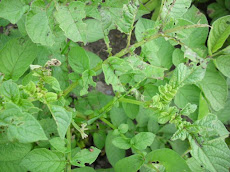
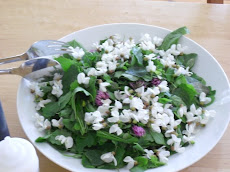
Yesterday, Eric, Ellyn, Hannah and I took a break from farm work and headed down to Shelburne Farms, for a day of foraging! Shelburne Farms sits on a 1400 acre lot just outside Burlington. It’s a gorgeous and huge old, fully working farm, with an extensive cheese making production, sheep, cattle, gardens, an inn, children’s center and lots more. We took a “workshop” on wild edibles, but workshop luckily wouldn’t exactly be the best word to describe it! We foraged through the woods of Shelburne digging up burdock, rolled up our pants and trampled through the marshy muck to peel and pull up cattails, and plucked the flowering top of milkweeds on a hillside by the garden. We also pulled up some edible weeds, like lambs quarter in the garden, but seeing as this was a day away from pulling up weeds; I decided to take some pictures at that part instead! After our group finished our foraging adventure, we all helped prepare lunch at a rental house on the Shelburne property, which overlooked an astonishing lake front view of Lake Champlain. My camera unfortunately couldn’t even come close to capturing it's beauty! The meal tasted delicious, and the four of us were especially fans of the milkweed, which we ate in fried little fritters and sautéed with butter and garlic in our pasta.
Don’t overlook all wild plants or even weeds in your garden! Many of them may surprise you and taste quite good, but make sure it’s edible, there’s a lot of look a likes! Here are some wild edibles we foraged for and ate:
Amaranth (Also known as pigweed, used in the salad)
Stinging Nettle (They’re a pain to weed and leave you with stinging rashes on your hands if you’re not careful, and surprisingly can be eaten when cooked, but none of us were a big fan of this in our pasta.)
Lambs Quarter (Very common garden weed, and good on a salad!)
Red Clover (I think I might have been one of the only ones in our group not to know this was the Vermont State Flower! It’s pretty as well as tasty, and makes a nice topping to a salad)
Cattails (Peel off the bottom husks, and slip the stem out of the ground and there’s a gooey aloe like covering! The white part of the stem can be chopped up, tastes a little like a cucumber, but not as flavorful. This was the most fun and most messy wild edible to forage for!)
Burdock (The root of first year burdock plants can be dug up and cooked, and the middle stem of second year burdocks can be peeled and eaten, but we found that the work getting these isn’t necessarily worth what you get out of it.)
Milkweed (So delicious! Fry it up into milkweed fritters, easily a crowd pleaser, also tasty sautéed with different seasonings, or with the ever wonderful butter.)
There were a lot more, I just can’t really think of them right now! But defiantly look around your yards and parks for some of these wild edibles! Make sure you take noticed of where they are however, plants close to a road side aren’t the best places to forage for example, due to possible run off’s from the road and such. Weeds from your garden might be your best bet and milkweed of course!
And lastly, for a farming related side note, many of you I’m sure have become all too accustomed to hearing about the hardships of dairy farmers in our country. Prices drop at unbelievably fast rates and so many family run dairy farms are forced to end their operation. Here’s something you can do to help! It’s a letter to push the urgency of the problem to people who can actually make decisions to fix the crisis. Sign if you wish! http://act.credoaction.com/campaign/vilsack_milk/?r_by=4487-857473-XJ1kkTx&rc=paste
Don’t overlook all wild plants or even weeds in your garden! Many of them may surprise you and taste quite good, but make sure it’s edible, there’s a lot of look a likes! Here are some wild edibles we foraged for and ate:
Amaranth (Also known as pigweed, used in the salad)
Stinging Nettle (They’re a pain to weed and leave you with stinging rashes on your hands if you’re not careful, and surprisingly can be eaten when cooked, but none of us were a big fan of this in our pasta.)
Lambs Quarter (Very common garden weed, and good on a salad!)
Red Clover (I think I might have been one of the only ones in our group not to know this was the Vermont State Flower! It’s pretty as well as tasty, and makes a nice topping to a salad)
Cattails (Peel off the bottom husks, and slip the stem out of the ground and there’s a gooey aloe like covering! The white part of the stem can be chopped up, tastes a little like a cucumber, but not as flavorful. This was the most fun and most messy wild edible to forage for!)
Burdock (The root of first year burdock plants can be dug up and cooked, and the middle stem of second year burdocks can be peeled and eaten, but we found that the work getting these isn’t necessarily worth what you get out of it.)
Milkweed (So delicious! Fry it up into milkweed fritters, easily a crowd pleaser, also tasty sautéed with different seasonings, or with the ever wonderful butter.)
There were a lot more, I just can’t really think of them right now! But defiantly look around your yards and parks for some of these wild edibles! Make sure you take noticed of where they are however, plants close to a road side aren’t the best places to forage for example, due to possible run off’s from the road and such. Weeds from your garden might be your best bet and milkweed of course!
And lastly, for a farming related side note, many of you I’m sure have become all too accustomed to hearing about the hardships of dairy farmers in our country. Prices drop at unbelievably fast rates and so many family run dairy farms are forced to end their operation. Here’s something you can do to help! It’s a letter to push the urgency of the problem to people who can actually make decisions to fix the crisis. Sign if you wish! http://act.credoaction.com/campaign/vilsack_milk/?r_by=4487-857473-XJ1kkTx&rc=paste
Monday, June 15, 2009
Life on an organic farm is....growing up more and more from the ground everyday!
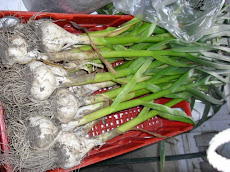
By harvesting, washing and bagging lettuce, Swiss chard, mixed kale, spinach, chives, radishes, oregano and rhubarb on Sunday, we prepared ourselves for the first CSA pickup of the season! I loved finally being able to harvest some of what we’ve worked hard at planting, transplanting, mulching, watering and weeding. Digging up the radishes is a risk, as you can’t really tell which ones are big enough sizes to harvest, pretty much until you pull them up from the dirt. The red color though was so bright! Aaaaand this is how I can tell I’m getting a little too into my vegetables ha ha, commenting on the vibrant colors; but it is quite rewarding watching your vegetables grow, but perhaps not as rewarding as eating them. :)
Hannah and I loaded up the van later this morning with all our fresh veggies and headed down some country roads to the hospital in St Albans (a larger town about 10 minutes away from Highgate). Set up was similar to the farmers market, and we laid out all of the components of this week’s share on a picnic table outside the hospital, so people could choose for themselves which ones they wanted. Four people however, didn’t pick up there share this week! It’s the first week, so perhaps they didn’t remember, but regardless, it their loss, as the three of us interns made an apple crisp with some fresh rhubarb in it last night and it tasted quite delicious. :)
When we returned back at Maplewood, I joined up with Ellyn and Eric in the field for an afternoon of weeding. Thunder from afar and threatening skies in the distance kept us anticipating a storm for the last couple hours of weeding, but luckily it held off pretty much until we ran inside from the rain at the end of the day.
Hannah and I loaded up the van later this morning with all our fresh veggies and headed down some country roads to the hospital in St Albans (a larger town about 10 minutes away from Highgate). Set up was similar to the farmers market, and we laid out all of the components of this week’s share on a picnic table outside the hospital, so people could choose for themselves which ones they wanted. Four people however, didn’t pick up there share this week! It’s the first week, so perhaps they didn’t remember, but regardless, it their loss, as the three of us interns made an apple crisp with some fresh rhubarb in it last night and it tasted quite delicious. :)
When we returned back at Maplewood, I joined up with Ellyn and Eric in the field for an afternoon of weeding. Thunder from afar and threatening skies in the distance kept us anticipating a storm for the last couple hours of weeding, but luckily it held off pretty much until we ran inside from the rain at the end of the day.
Friday, June 12, 2009
Life on an organic farm is...possible through people buying your products.
Today, a mini van and a Rav4 filled with frozen meat, fresh lettuce and more, headed down to Westford, Vermont, for the first farmers market of the season! We went out into the garden this morning to cut a mix of lettuce, which we when washed, spun to dry and bagged to sell, and then packed an assortment of frozen beef cuts into a cooler to sell. At the market, which welcomed about 10 or so vender's, we sold the meat and lettuce, along with eggs and sauerkraut, all from Maplewood, and bottles of sunflower oil, which their neighbors produce. Hannah, Ellyn, Eric, Maddie, Calvin and I all went to sell. Most of the time, farmers just stay by their stand, but at the end it's interesting, because some really get into bartering with you. We ended up trading some of our eggs and ground beef for some delicious bread from one eager barterer! I walked around for a little bit with Maddie and Calvin, who love to save their pennies to spend on treats at markets. They chose some muffins and brownies, each under a dollar, and but wandering Calvin would walk off with his treat without paying for it first! It's good thing I was in charge of his money!
Since the market was fairly small, and it was the first one of the season, the turn out unfortunately wasn't the best, but Maplewood defiantly got it's name out there.
If you don't live in an area where much CSA action goes on, or don't have the right type of yard for a garden, buying veggies, meat, jams, honey, maple syrup, bread and so much more from markets is a great way to support local and hard working farmers! The food is fresh, not always necessarily organic, but local, cutting back on the environmental impact of the food. Sometimes food at farmers markets may seem more expensive, like meat, but other times you're saving compared to grocery stores, like with vegetables. Either or though, your money's going straight to the person who prepared the food, and goes directly into building your local economy. Wallets are tight, but this really is a great way to spend your money, and think about it, would you rather buy bagged lettuce from your grocery store, when you don't know where it came from, how long it's been since it was harvested, unsure of what chemicals it soaked up while growing, over lettuce picked that morning from a farm less than 30 miles away???
Just to increase knowledge of the food industry, the movie Food Inc. hits theaters soon, here's a link to watch a preview! http://www.foodincmovie.com/
Since the market was fairly small, and it was the first one of the season, the turn out unfortunately wasn't the best, but Maplewood defiantly got it's name out there.
If you don't live in an area where much CSA action goes on, or don't have the right type of yard for a garden, buying veggies, meat, jams, honey, maple syrup, bread and so much more from markets is a great way to support local and hard working farmers! The food is fresh, not always necessarily organic, but local, cutting back on the environmental impact of the food. Sometimes food at farmers markets may seem more expensive, like meat, but other times you're saving compared to grocery stores, like with vegetables. Either or though, your money's going straight to the person who prepared the food, and goes directly into building your local economy. Wallets are tight, but this really is a great way to spend your money, and think about it, would you rather buy bagged lettuce from your grocery store, when you don't know where it came from, how long it's been since it was harvested, unsure of what chemicals it soaked up while growing, over lettuce picked that morning from a farm less than 30 miles away???
Just to increase knowledge of the food industry, the movie Food Inc. hits theaters soon, here's a link to watch a preview! http://www.foodincmovie.com/
Subscribe to:
Posts (Atom)



















.JPG)
.JPG)



.jpg)
.JPG)






.JPG)
.JPG)